

CURRICULUM • PRE-ENGINEERING • TEACHER LICENSURE • ORGANIZATIONS • SCHOLARSHIPS • CAREER INFO • STUDENT INFORMATION • USEFUL LINKS
cURRICULUM
This program is no longer accepting new students. Please explore UNCG’s other academic programs.
For current students:
Bachelor of Arts Physics Major (BA)
Take all the physics courses through the 300-level. No 400-level courses are required. 26 required credits of PHY
Bachelor of Science Physics Major (BS)
Take 9 credits of 400-level courses in addition to the lower level courses. 36 required credits of PHY.
BA or BS Degrees with Standard Professional Licensure for Teachers
Minoring in Physics
A minimum of 15 semester hours in physics courses is to be planned in consultation with a physics faculty member. The usual physics minor program will consist of PHY 291, 292, and at least 7 semester hours of additional courses (excluding PHY 203, 209, 235, 205, 333, and 334). Other, quite different programs may be fitted to the individual student’s interests and objectives.
Pre-Engineering
While UNCG does not have an engineering school we provide a great 2-year preparation in basic physics and mathematics that will allow a student to transfer to one of North Carolina’s outstanding engineering schools to complete an engineering degree. A pre-engineering student would come to UNCG to learn the basic math and physics required of all engineers but do this in our smaller classes. After two years the pre-engineering student would transfer to a university that offers an engineering degree if the student has demonstrated mastery of the basic math, physics and computational skills.
The pre-engineering program is described, including a course schedule, in the UNCG Undergraduate Bulletin (Under Preprofessional Programs in the Undergraduate Bulletin).
The pre-engineering advisors are:
BA or BS Degrees with Standard Professional Licensure for Teachers
For students interested in teaching as a career: Our need for good physics teachers at the high school and middle school levels has never been greater. Job opportunities are plentiful for someone who knows physics well, and is prepared to teach it.
If you are interested in earning teacher licensure along with a physics BA or BS degree, you should begin to take the introductory physics and math sequence as early as possible in your college career. Introductory Calculus (MAT 196 & 296) is required for General Physics (PHY 291 & 292), and two subsequent math courses are necessary for upper-level physics courses.
Introductory physics (PHY 291) is only offered in spring semesters. Take this class in your freshman year if at all possible.
All Physics Students should measure e/m for the electron
The pictures below show the effect of a magnetic field on the path of a 60 eV electron beam. (A 60 eV electron travels at nearly 5 million meters per second.)
| Without B-Field | With B-Field |
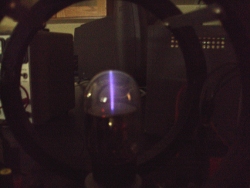 | 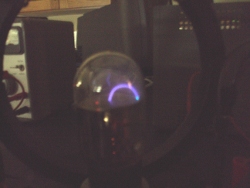 |
| See it in action! e/m for Electron 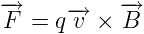 | |
The Lorenz System
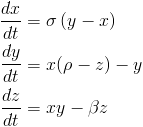
In 1963 Edward Lorenz introduced a simple 3-variable model for convection in the atmosphere. The model consists of the 3 first-order nonlinear differential equations shown below. For some parameter values the solutions of these equations are chaotic. This suggests why long-term daily weather forecasts are not possible.
The video shows phase-space behavior of an analog computer for the Lorenz system. The analog computer was constructed one night in the lab by Jarrett Lancaster, one of our physics majors, just for fun because it was interesting.
| See it in action! | |
 |